
 Australian Apitherapy Association October 5, 2025
Apitherapy for Alzheimer’s Disease
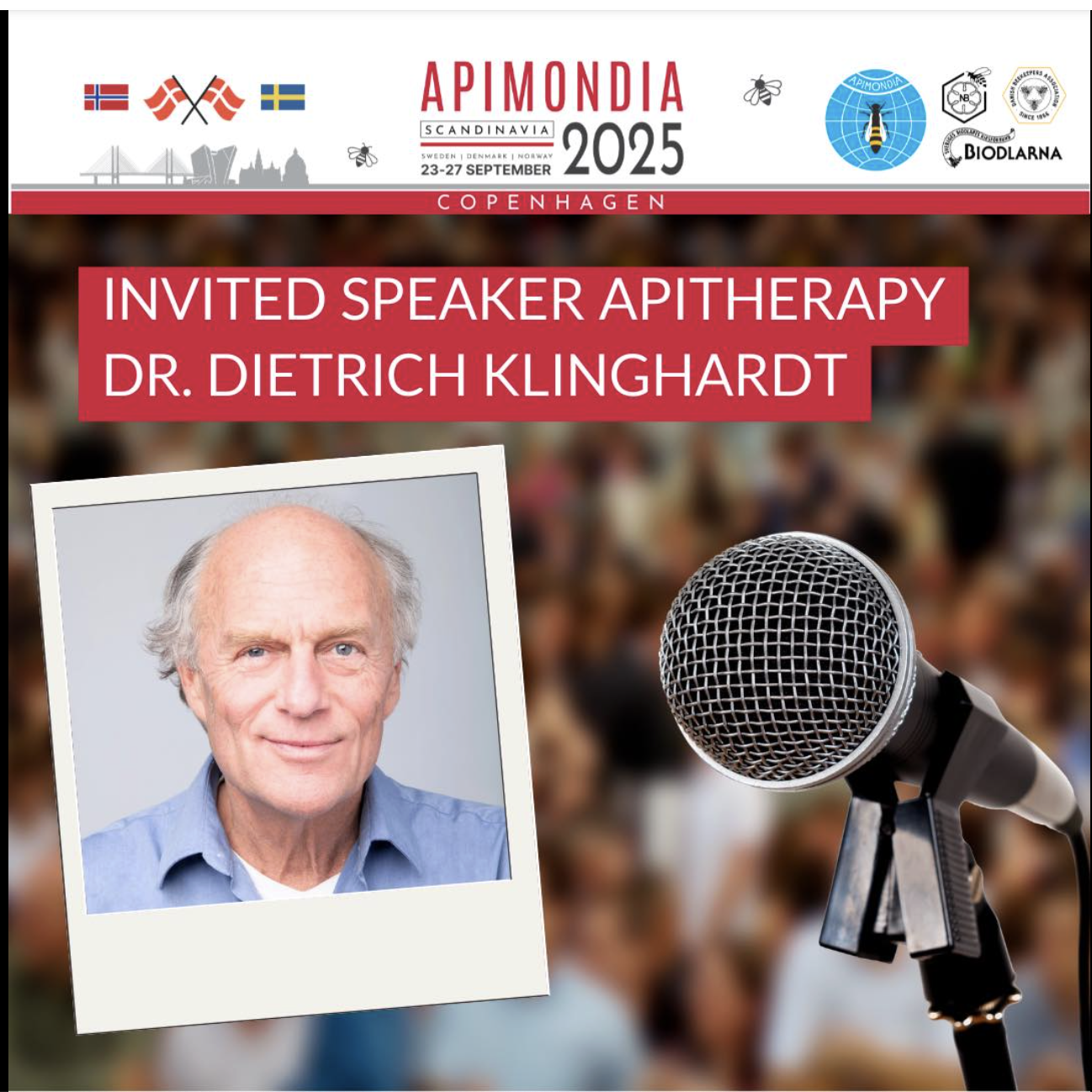
Internationally recognized physician, Dr. Dietrich Klinghardt, MD, PhD, has addressed a major international forum on the power of apitherapy for the treatment of Alzheimer’s disease.
Dr Klinghardt described in his speech two controversial possible causes of Alzheimer’s that are rarely discussed- the link between Lyme disease and the gum disease Porphyromonas gingivalis, gram-negative bacteria, known to be the keystone species causing chronic periodontitis
As part of his presentation Dr Klinghardt cited many peer reviewed journals showing evidence that bee medicine can be helpful for the treatment of Alzheimer’s and other neurological conditions by addressing these two conditions.
Dr Klinghardt is the founder and Medical Director of the Sophia Health Institute in Washington, USA, and the Institute of Neurobiology Klinghardt in Germany.
His innovative approaches integrate immunology, endocrinology, toxicology, and neural therapy to address complex conditions such as neurological diseases, chronic pain, Lyme disease, and autism.
In his address Dr Klinghardt addressed the complexity of diagnosing Lyme disease and described his forty years of using bee venom in his practice for addressing chronic illness.
“The treatment with regular bee venom injections (or direct application of bee stings since the early part of the 1800ds) has been used successfully for the treatment of arthritis, chronic fatigue and other debilitating illnesses, Dr Klighardt told the Apimondia conference last week in Copenhagen.
“I use injectable bee venom at the Sophia Health Institute in selected patients as a long-term wellness modality that improves cognitive function, pain levels, mood-disorders, autoimmunity and many other symptoms.”
“I slowly increase the dose of bee venom used – to the equivalent of 10 stings twice weekly.
Dr Klinghardt described the controversy surrounding studies since he had published in 2006 studies linking Lyme disease and Alzheimer’s. Dr Klinghardt described the effectiveness of addressing such infections with bee venom and also bee propolis, citing many studies, including as recently as 2024, confirming this.
Dr Klighardt also described a possible connection between Alzheimer’s Disease and Porphyromonas gingivalis. He listed a series of peer reviewed studies examining how bee propolis could be used as an effective treatment for Porphyromonas gingivalis. More details about Dr. Dietrich Klinghardt can be found at https://sophiahi.com
Studies cited by Dr Klinghardt in his lecture are listed below:
Does Borrelia cause Alzheimer’s disease?
◦ MacDonald AB. Plaques of Alzheimer’s disease originate from cysts of Borrelia burgdorferi, the Lyme disease spirochete. Med Hypotheses. 2006;67(3):592-600. doi: 10.1016/j.mehy.2006.02.035. Epub 2006 May 3. PMID: 16675154.
The 2006 paper “Plaques of Alzheimer’s disease originate from cysts of Borrelia burgdorferi” by A. B. MacDonald proposes a controversial hypothesis that the characteristic plaques of Alzheimer’s disease are derived from cystic forms of Borrelia burgdorferi, the Lyme disease-causing bacterium. The paper suggests that these cystic forms of the spirochete, which may persist in the brain, resemble the plaques and could be the origin of the amyloid core found in Alzheimer’s plaques.
◦
Miklossy J, Khalili K, Gern L, Ericson RL, Darekar P, Bolle L, Hurlimann J, Paster BJ. Borrelia burgdorferi persists in the brain in chronic lyme neuroborreliosis and may be associated with Alzheimer disease. J Alzheimers Dis. 2004 Dec;6(6):639-49; discussion 673-81. doi: 10.3233/jad-2004-6608. PMID: 15665404.
Blanc F, Philippi N, Cretin B, Kleitz C, Berly L, Jung B, Kremer S, Namer IJ, Sellal F, Jaulhac B, de Seze J. Lyme neuroborreliosis and dementia. J Alzheimers Dis. 2014;41(4):1087-93. doi: 10.3233/JAD-130446. PMID: 24762944.
Herrera-Landero A, Amaya-Sánchez LE, D Hyver de Las-Deses C, Solórzano-Santos F, Gordillo-Pérez MG. Borrelia burgdorferi as a risk factor for Alzheimer’s dementia and mild cognitive impairment. Eur Geriatr Med. 2019 Jun;10(3):493-500. doi: 10.1007/s41999-018-0153-0. Epub 2019 Jan 10. PMID: 34652786.
Meer-Scherrer L, Chang Loa C, Adelson ME, Mordechai E, Lobrinus JA, Fallon BA, Tilton RC. Lyme disease associated with Alzheimer’s disease. Curr Microbiol. 2006 Apr;52(4):330-2. doi: 10.1007/s00284-005-0454-7. Epub 2006 Mar 9. PMID: 16528463.
◦
◦ Porphyromonas gingivalis as a strong risk factor for Alzheimer’s disease
Dominy SS, Lynch C, Ermini F, Benedyk M, Marczyk A, Konradi A, Nguyen M, Haditsch U, Raha D, Griffin C, Holsinger LJ, Arastu-Kapur S, Kaba S, Lee A, Ryder MI, Potempa B, Mydel P, Hellvard A, Adamowicz K, Hasturk H, Walker GD, Reynolds EC, Faull RLM, Curtis MA, Dragunow M, Potempa J. Porphyromonas gingivalis in Alzheimer’s disease brains: Evidence for disease causation and treatment with small-molecule inhibitors. Sci Adv. 2019 Jan 23;5(1):eaau3333. doi: 10.1126/sciadv.aau3333. PMID: 30746447; PMCID: PMC6357742.
The study by Dominy et al. (2019) in Science Advances found that the periodontal pathogen Porphyromonas gingivalis (P. gingivalis) is linked to Alzheimer’s disease (AD) by identifying its presence in AD brains and demonstrating that its toxic proteases, gingipains, contribute to AD pathogenesis. The study showed that gingipain inhibition in mice with P. gingivalis brain infections reduced bacterial load, blocked the production of the amyloid-beta peptide (Aβ1–42), and alleviated neurodegeneration, suggesting that gingipain inhibitors could be a therapeutic strategy for AD.
◦
Kanagasingam S, Chukkapalli SS, Welbury R, Singhrao SK. Porphyromonas gingivalis is a Strong Risk Factor for Alzheimer’s Disease. J Alzheimers Dis Rep. 2020 Dec 14;4(1):501-511. doi: 10.3233/ADR-200250. PMID: 33532698; PMCID: PMC7835991.
Liu S, Butler CA, Ayton S, Reynolds EC, Dashper SG. Porphyromonas gingivalis and the pathogenesis of Alzheimer’s disease. Crit Rev Microbiol. 2024 Mar;50(2):127-137. doi: 10.1080/1040841X.2022.2163613. Epub 2023 Jan 4. PMID: 36597758.
Costa MJF, de Araújo IDT, da Rocha Alves L, da Silva RL, Dos Santos Calderon P, Borges BCD, de Aquino Martins ARL, de Vasconcelos Gurgel BC, Lins RDAU. Relationship of Porphyromonas gingivalis and Alzheimer’s disease: a systematic review of pre-clinical studies. Clin Oral Investig. 2021 Mar;25(3):797-806. doi: 10.1007/s00784-020-03764-w. Epub 2021 Jan 20. PMID: 33469718.
Elwishahy A, Antia K, Bhusari S, Ilechukwu NC, Horstick O, Winkler V. Porphyromonas Gingivalis as a Risk Factor to Alzheimer’s Disease: A Systematic Review. J Alzheimers Dis Rep. 2021 Sep 13;5(1):721-732. doi: 10.3233/ADR-200237. PMID: 34755046; PMCID: PMC8543378.
Fu Y, Xu X, Zhang Y, Yue P, Fan Y, Liu M, Chen J, Liu A, Zhang X, Bao F. Oral Porphyromonas gingivalis Infections Increase the Risk of Alzheimer’s Disease: A Review. Oral Health Prev Dent. 2023 Jan 18;21:7-16. doi: 10.3290/j.ohpd.b3818045. PMID: 36651311; PMCID: PMC11619833.